
Secrets of the Beasts: Animals in Medieval Manuscripts
/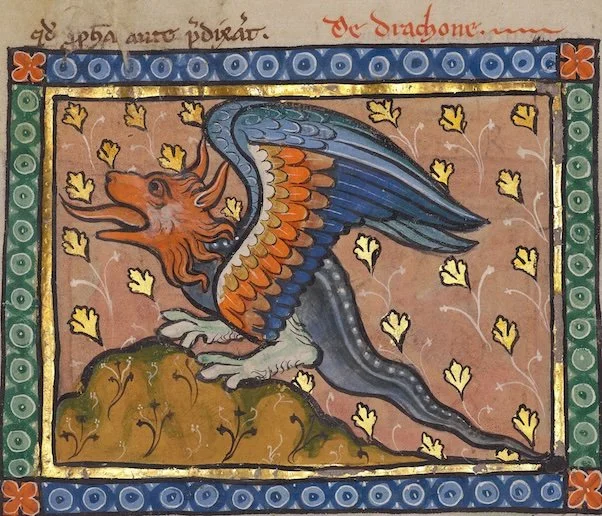
A Dragon, from a Bestiary, Therouanne(?), France, ca. 1270. Tempera, ink, and gold on parchment, 19.1 x 14.3 cm (7 1/2 x 5 5/8 in.). Los Angeles, J. Paul Getty Museum, Ms. Ludwig XV 3, fol. 89r.
Do animals carry secrets? Throughout the medieval period in Europe (from ca. 400 to ca. 1450 CE), animals are frequently found populating the pages of illustrated books. Artists used animals to tell stories, communicate religious beliefs, represent human behavior, and express ideas about the natural and supernatural worlds.
This exhibition explores examples of animal imagery in medieval illuminated manuscripts and highlights works from France, England, Spain, and Germany, made between the tenth and fifteenth centuries. It includes reproductions of examples from Jewish and Christian religious books and from more secular books, like a manual for hunting. Before the adoption of the printing press ca.1440, books were written and illustrated by hand, and hence they are often referred to as manuscripts. Many were made on parchment, a writing surface prepared from animal skin. Artists used ink, colorful pigments, and sometimes gold and silver to create detailed illustrations alongside written texts.
This exhibition begins with familiar animals. These creatures are easily recognizable, like a pelican, but they often hold extra meaning. The second section explores hybrids. These beasts—like sirens or centaurs—take on familiar characteristics of animals but are combined with other, sometimes unexpected beings. In the last section are fantastical fauna, supernatural and imaginary creatures like the dragon seen on the far wall. In many cases the images are not naturalistic. Instead, the artists have emphasized certain behaviors or events. Together, these images reveal how medieval artists transformed animals into powerful symbols that communicated meaning beyond their physical appearance.