MASPAZ: WE ALL BELONG
/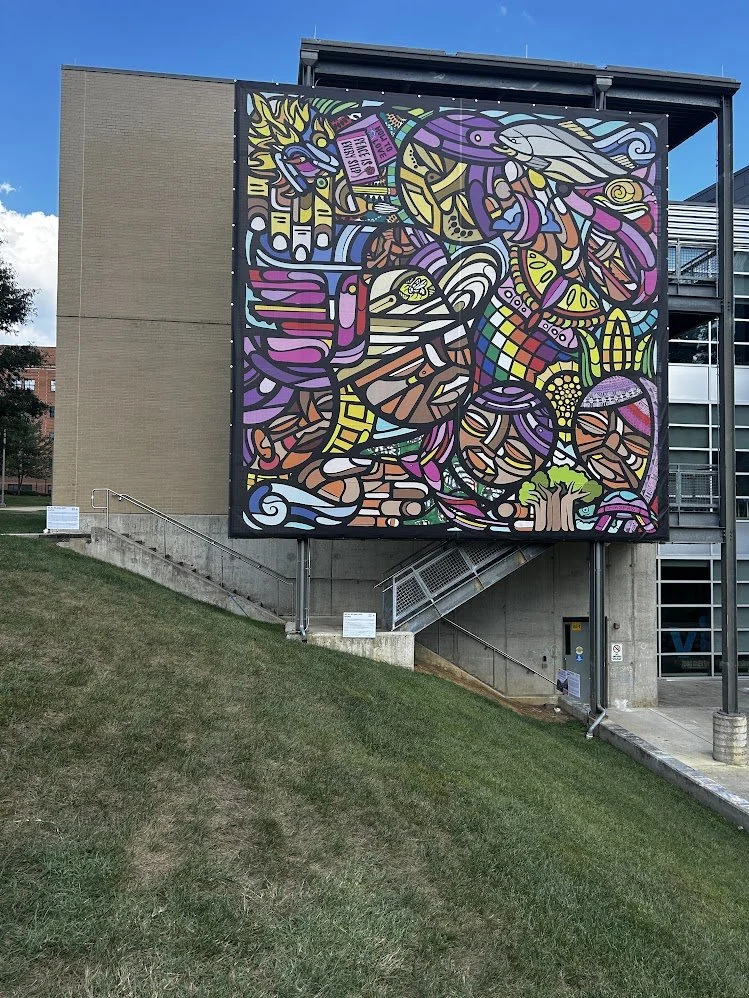
We All Belong, 2025
by MasPaz
Murals at Mason commissioned a tapestry mural from School of Art alumnus (‘05), Federico “MasPaz” Frum that conveys interconnectedness and reciprocity between humans, animals, and the natural world. The group of people represent the global origins of the Mason student community. They are embracing each other and are surrounded by a variety of patterns that reference animals, plants, and symbols of learning and creativity.
Animal elements: Dove, bear paw and human footprint, fox, snail, lion, turtle, hummingbird, butterfly, salmon.
Natural elements: Sky, sun, moon, cloud, wind, sea, fire, rainbow, corn, Baobab tree.
ARTIST STATEMENT
Friends and neighbors. Together we all sit. Birds and bees. Trees and leaves. With smiles through the eyes from the heart, we feel safe. Como estar en la casa. Like being home. The world is our home. We talk story, as newborns talk to their families.
Salmons swim, careful to not be caught by Fox Woman. Grandma walks home from the library, carrying her favorite books. She shares her stories with the community center for unhoused folks every Thursday. In the evenings she cares for her granddaughter, while the parents take night class and work cleaning offices from 5-11pm. It’s tiring work. Uncle sits under the red bud watching the colors of the sky painted with butterfly dust. Over the corn fields around the sun she flies.
The kindest couple cradle their 6 month old son. They offer him abundant love and care. They adopted him from an orphanage called the House of the Mother. Beside their house grows the Baobab, one of the largest trees in the world.
ABOUT THE ARTIST
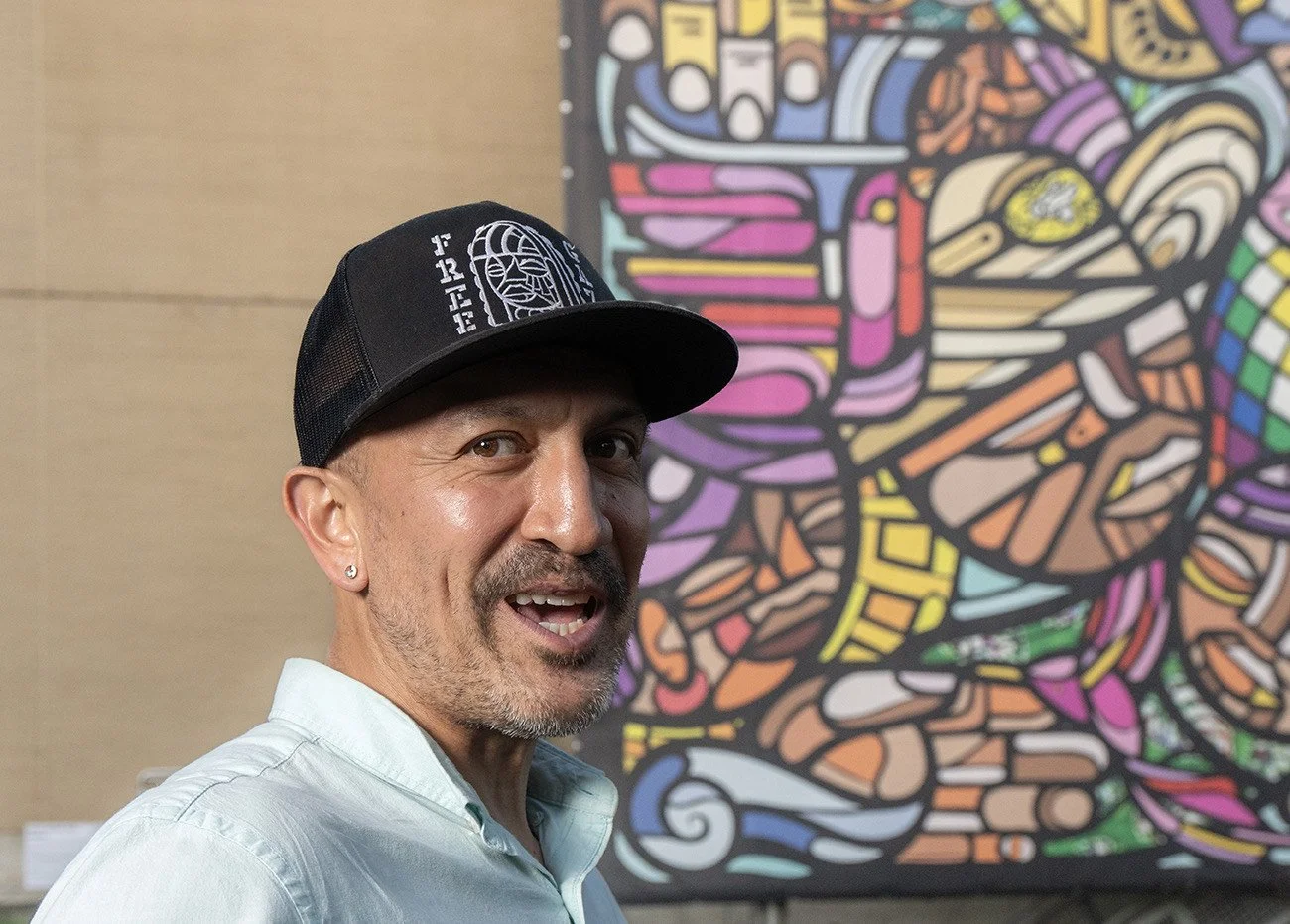
MasPaz (Federico Frum), an alumnus of Mason’s School of Art, is a Colombian-born multidisciplinary artist, based in Washington DC. He is known for his distinctive street murals that explore topics of earth preservation and indigenous peoples. He recently created the Art of the Skateboard, a series of stamps for the U.S. Postal Service. Mas Paz means 'more peace' in Spanish, a message he strives to embrace through art and philanthropy.
He has been featured on ABC News, Telemundo and The Washington Post, among others. He has collaborated with brands such as Nike, National Geographic, Roots, Sierra Club, and Brooks Running, as well as institutions such as the Smithsonian Institution, the National Portrait Gallery, the National Gallery of Art, the New Museum, the Corcoran, the Freer and Sackler Gallery. He has also worked with numerous schools and education centers throughout the world.
We Belong: Making Commons, Making Community
How do we make—and share—place? This display gathers artists, theorists, and organizers who reimagine belonging not as a private sentiment but as a shared, public practice. This display is inspired by We All Belong (2025), a new mural by MasPaz created in dialogue with Offering the Potomac: Acknowledging Indigenous Place. The mural reflects on interconnectedness and reciprocity among humans, animals, and the natural world.
From Meridel Rubenstein’s storied landscapes of Los Alamos and Vietnam to Ray Oldenburg’s notion of “third places,” these selections trace how people co-create spaces of care, memory, and conviviality. The commons appears here as both method and horizon: Elinor Ostrom’s field-defining work on collective governance sits alongside contemporary studies of cultural, digital, and urban commons. Texts on migration and sociolinguistics explore how language, mobility, and policy shape who gets to belong, while philosophy and evolutionary anthropology ask what kinship and friendliness make possible.
Together, these works offer both practical tools and imaginative frameworks for stewarding resources, cultivating publicness, and repairing relations—so that belonging becomes something we make, and remake, together.
Keywords: belonging, commons, community, place-making, public practice, reciprocity, interconnectedness, conviviality, care, memory, kinship, friendliness, repair, publicness
Books at Provisions Library
Belonging: Los Alamos to Vietnam — Meridel Rubenstein (2004)
All That We Share: A Field Guide to the Commons — Jay Walljasper (2010)
Capitalism 3.0: A Guide to Reclaiming the Commons — Peter Barnes (2006)
Silent Theft: The Private Plunder of Our Common Wealth — David Bollier (2002)
The Great Good Place: Cafes, Coffee Shops, Bookstores, Bars, Hair Salons, and Other Hangouts at the Heart of a Community — Ray Oldenburg (1999)
Being Public: How Art Creates the Public — Jeroen Boomgaard & Rogier Brom (eds.) (2017)
Governing the Commons: The Evolution of Institutions for Collective Action — Elinor Ostrom (1990) from Mason University Libraries’ collection
Precarity and Belonging: Labor, Migration, and Noncitizenship — Catherine S. Ramírez et al. (eds.) (2021) Online/from Mason University Libraries’ collection
Contested Belonging: Spaces, Practices, Biographies — Kathy Davis, Halleh Ghorashi & Peer Smets (eds.) (2018)
The Sociolinguistics of Place and Belonging: Perspectives from the Margins — Leonie Cornips & Vincent A. De Rooij (eds.) (2018)
A Philosophy of Belonging: Persons, Politics, Cosmos — James Greenaway (2023)
Making Commons Dynamic: Understanding Change Through Commonisation and Decommonisation — Prateep Kumar Nayak (ed.) (2021)
Cultural Commons: A New Perspective on the Production and Evolution of Cultures — Enrico Eraldo Bertacchini et al. (eds.) (2012)
Survival of the Friendliest: Understanding Our Origins and Rediscovering Our Common Humanity — Brian Hare & Vanessa Woods (2020)
PROJECT MANAGERS
Yassmin Salem
Donald Russell
Dr. Gabrielle Tayac
Caroline Sonner
SPONSORS
University Life
Patriot Green Fund from Facilities and Campus Operations